Research notes
KiWiS keeps the explanatory layer that sits between source material and finished artifacts. Notes are concise, linked to evidence, and revised as the underlying research changes.
Resolved stellar populations
The current astronomy work uses resolved stars as tracers of low-surface-brightness structure around nearby galaxies. The record focuses on three questions:
- How were overlapping HST detections removed without distorting the spatial distribution?
- Which background model is appropriate for each galaxy environment?
- Does a candidate feature remain significant under Poisson counting uncertainty?
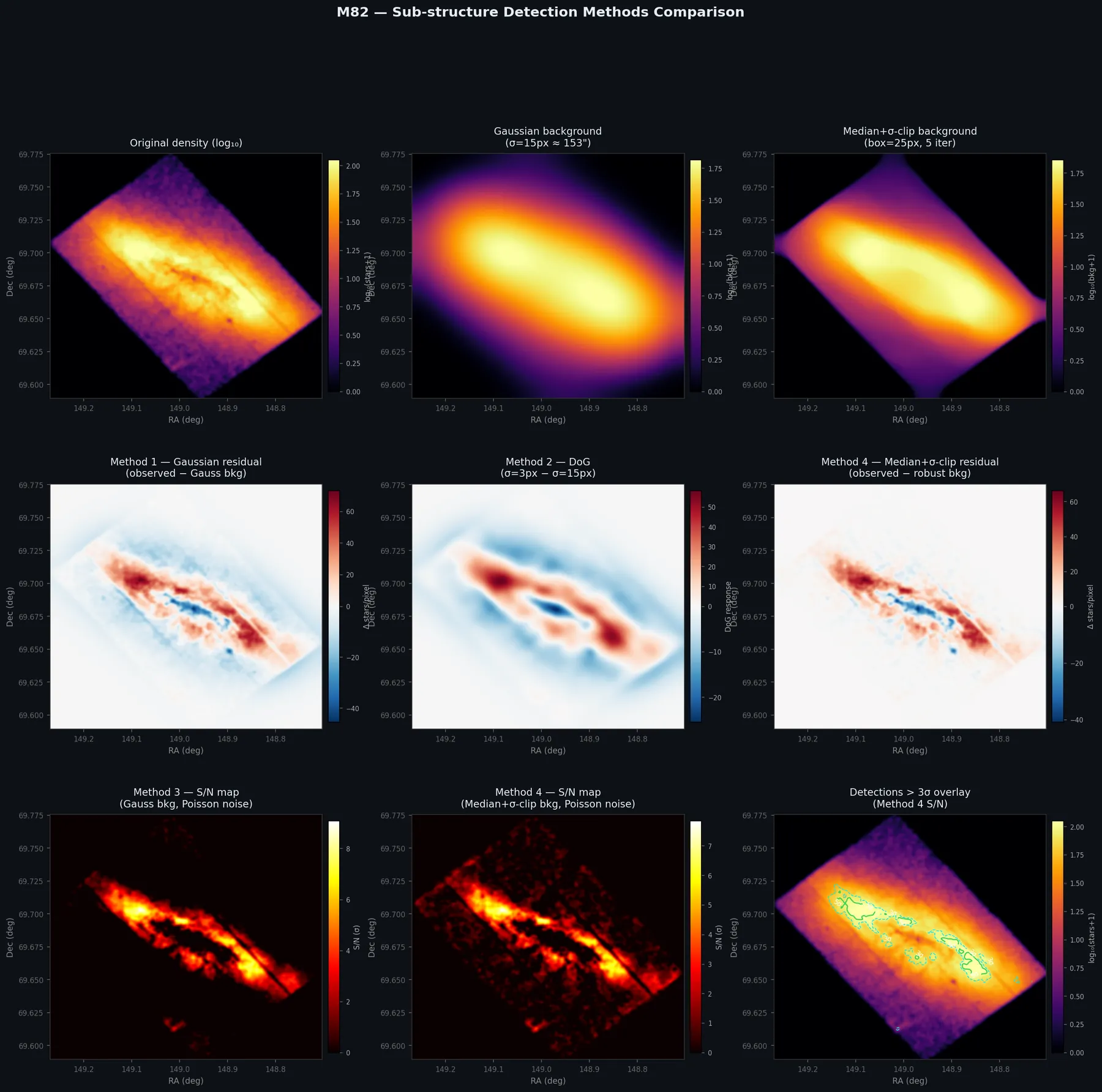
Nine aligned views make it easier to distinguish persistent structure from features produced by one detector.
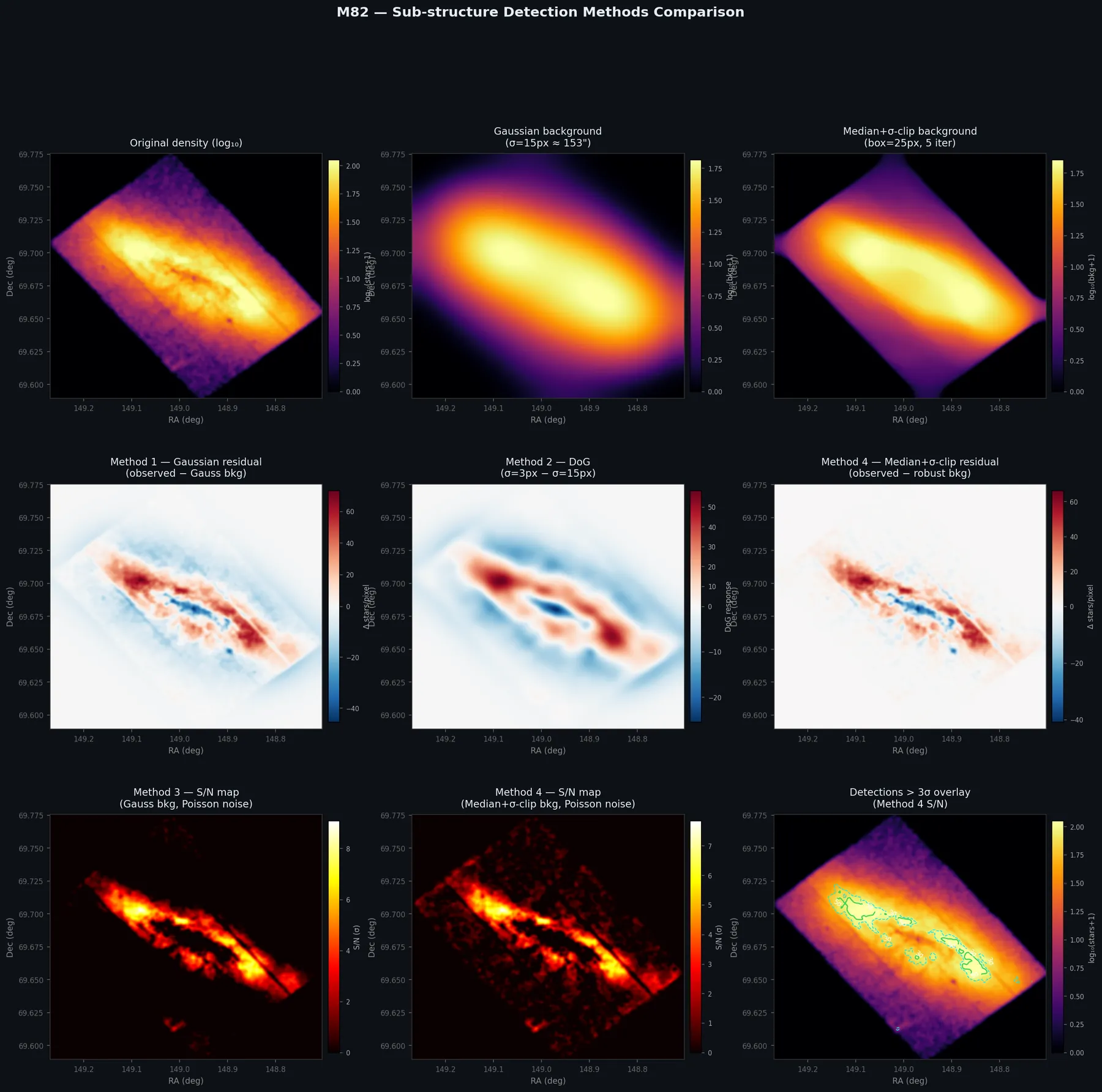
Read the M81/M82 method ledger →
Ontology engineering
The ontology track documents how domain concepts become explicit classes, properties, constraints, and inference rules. Current work includes an ontology-augmented health-service recommendation system with SWRL reasoning and SPARQL-based inspection.
The durable lesson is architectural: a recommendation should remain traceable to modeled domain knowledge rather than only to an opaque score.
Knowledge graphs
The graph track connects papers, projects, datasets, methods, and technical dependencies. Provenance is treated as part of the data model: every relationship should retain enough context to answer where it came from and why it exists.
Note lifecycle
- Capture a question or observation.
- Link the relevant source, dataset, or figure.
- Record the method and assumptions.
- Promote stable explanations into a method ledger or glossary entry.
- Preserve superseded material when it remains historically useful.